Search results
sequence :: forall t a m. Traversable t => Applicative m => t (m a) -> m (t a)sequence1 :: forall t b f. Traversable1 t => Apply f => t (f b) -> f (t b)sequence1Default :: forall t a m. Traversable1 t => Apply m => t (m a) -> m (t a)A default implementation of sequence1 using traverse1.
sequenceDefault :: forall t a m. Traversable t => Applicative m => t (m a) -> m (t a)A default implementation of sequence using traverse.
distribute :: forall f a g. Distributive f => Functor g => g (f a) -> f (g a)distributeDefault :: forall a f g. Distributive f => Functor g => g (f a) -> f (g a)A default implementation of distribute, based on collect.
parSequence :: forall a t m f. Parallel f m => Applicative f => Traversable t => t (m a) -> m (t a)sequence :: forall m p q a. Dissect p q => MonadRec m => p (m a) -> m (p a)A tail-recursive sequence operation, implemented in terms of Dissect.
sequence :: forall c b a. HasApply b => HasMap b => HasTraverse a => HasPure b => a (b c) -> b (a c)Sequences actions and collects the results.
sequence [Just 1, Just 2] -- Just [1, 2]
inParallel :: forall f m a. Parallel f m => Applicative f => Array (m a) -> m (Array a)Run multiple computations in parallel, and collect all results
To only take the fastest result, use race
useHooks :: forall m a. MonadHooks m => Signal (m a) -> m (Signal a)Unwrap a Signal
dynamic :: forall m a. MonadReplace m => MonadFRP m => Dynamic (m a) -> m (Dynamic a)useHooks :: forall m a. MonadHooks m => Signal (m a) -> m (Signal a)Unwrap a Signal
weakDynamic :: forall m a. MonadReplace m => MonadFRP m => WeakDynamic (m a) -> m (WeakDynamic a)all :: forall a g f. Deferred => Foldable f => Unfoldable g => f (Promise a) -> Promise (g a)Run all promises in the given Foldable, returning a new promise which either
resolves to a collection of all the given promises' results, or rejects with
the first promise to reject.
pivotAxes :: forall f a. Applicative f => Monoid (f a) => Foldable f => f (Vector3 a) -> { x :: f a, y :: f a, z :: f a }all :: forall a. Array (LazyPromise a) -> LazyPromise (Array a)all :: forall a. Array (LazyPromise a) -> LazyPromise (Array a)unwrap :: forall a. Signal (Effect a) -> Effect (Signal a)Takes a signal of effects of a, and produces an effect which returns a
signal which will take each effect produced by the input signal, run it,
and yield its returned value.
countQueuingStrategy :: forall a. { highWaterMark :: Int } -> Effect (QueuingStrategy a)new :: forall chunk. { highWaterMark :: Int, size :: chunk -> Int } -> Effect (QueuingStrategy chunk)useEffect :: forall m a. MonadHooks m => Signal (Effect a) -> m (Signal a)Unwrap effective Signal
all :: forall a. NotJSPromise a => Array (PromiseSpec a) -> PromiseSpec (Array a)Process all promise specs in an array
mkAdapter :: forall nodeRow. { nodesRef :: Ref (Array (MinimalNode nodeRow)), reheatFn :: Effect Unit, reinitForcesFn :: Effect Unit } -> EngineAdapter (MinimalNode nodeRow)Create an EngineAdapter from D3 kernel components.
This bridges the generic core engine with D3-specific functionality. The adapter provides position capture/update and rule application.
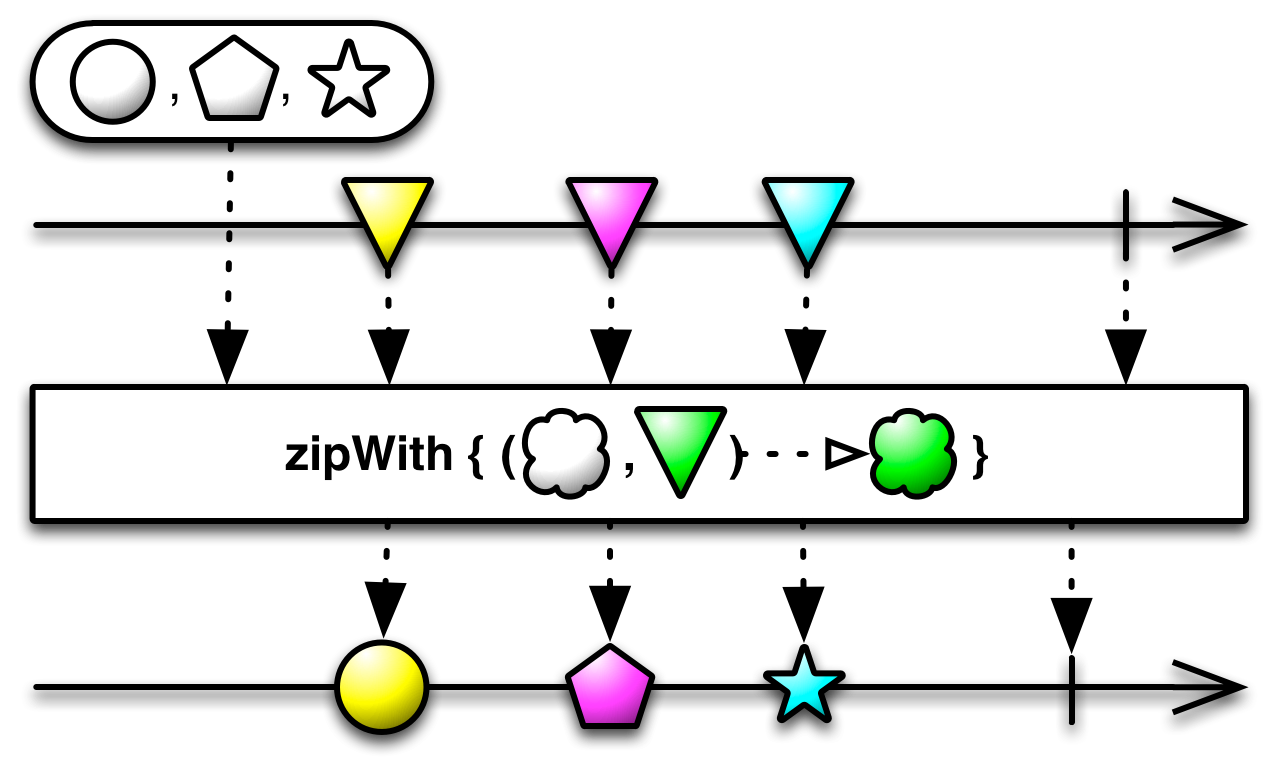
zip :: forall a. Array (Observable a) -> Observable (Array a)Waits for each ObservableImpl to emit a value. Once this occurs, all values
with the corresponding index will be emitted. This will continue until at
least one inner ObservableImpl completes.
all :: forall v. Array (Promise v) -> Promise (Array v)Documentation: Promise.all()
allSettled :: forall v. Array (Promise v) -> Promise (Array v)Documentation: Promise.allSettled()
any :: forall v. Array (Promise v) -> Promise (Array v)Documentation: Promise.any()
combineLatestAll :: forall a. List (Observable a) -> Observable (List a)cons :: forall a. Ord a => { head :: a, tail :: List a } -> Maybe (List a)performEvent :: forall m a. MonadFRP m => Event (Aff a) -> m (Event a)Run asynchronous action when an Event occurs. The returned Event will fire when such an action completes.
Note: the results may arrive in a different order than the requests.
pivotNonEmptyAxes :: forall a. NonEmptyArray (Vector3 a) -> { x :: NonEmptyArray a, y :: NonEmptyArray a, z :: NonEmptyArray a }runRule :: forall m. MonadEffect m => MonadThrow Error m => { assertViolationMessage :: String -> m Unit, module :: String, rule :: Rule } -> m (Array String)runRule' :: forall m. MonadEffect m => MonadThrow Error m => { module :: String, rule :: Rule } -> m (Violations ())runWhine :: forall m. MonadEffect m => { configFile :: FilePath, env :: Env, factories :: RuleFactories, globs :: Maybe (NonEmptyArray NonEmptyString) } -> m (Violations (WithRule + WithMuted + WithFile + ()))The main entry point into the linter. It takes some basic parameters and runs the whole thing: reads the config, parses it, instantiates the rules, globs the input files, parses them, and runs the rules through every file.
sequenceShrinkList :: forall a. List (Tree a) -> Tree (List a)Turn a list of trees in to a tree of lists, opting to shrink both the list itself and the elements in the list during traversal.
sequenceShrinkOne :: forall a. List (Tree a) -> Tree (List a)Turn a list of trees in to a tree of lists, opting to shrink only the elements of the list (i.e. the size of the list will always be the same).
useEffect :: forall m a. MonadHooks m => Signal (Effect a) -> m (Signal a)Unwrap effective Signal
zip :: forall a. Array (Observable a) -> Observable (Array a)Waits for each ObservableImpl to emit a value. Once this occurs, all values
with the corresponding index will be emitted. This will continue until at
least one inner ObservableImpl completes.
zip :: forall a. Array (AsyncSubject a) -> AsyncSubject (Array a)Waits for each AsyncSubject to emit a value. Once this occurs, all values with the corresponding index will be emitted. This will continue until at least one inner AsyncSubject completes.
zip :: forall a. Array (BehaviorSubject a) -> BehaviorSubject (Array a)Waits for each BehaviorSubject to emit a value. Once this occurs, all values with the corresponding index will be emitted. This will continue until at least one inner BehaviorSubject completes.
zip :: forall a. Array (Observable a) -> Observable (Array a)Waits for each Observable to emit a value. Once this occurs, all values
with the corresponding index will be emitted. This will continue until at
least one inner observable completes.
zip :: forall a. Array (ReplaySubject a) -> ReplaySubject (Array a)Waits for each ReplaySubject to emit a value. Once this occurs, all values with the corresponding index will be emitted. This will continue until at least one inner ReplaySubject completes.
byteLengthQueuingStrategy :: { highWaterMark :: Int } -> Effect (QueuingStrategy Uint8Array)
layoutADT :: { constructors :: Array { args :: Array RenderType, name :: String }, keyword :: Maybe String, name :: String, typeParams :: Array String } -> { dimensions :: Dimensions, layout :: LayoutNode }Lay out a data type with constructor branches.


layoutClassDef :: { methods :: Array { ast :: Maybe RenderType, name :: String }, name :: String, superclasses :: Array SuperclassInfo, typeParams :: Array String } -> { dimensions :: Dimensions, layout :: LayoutNode }Lay out a type class definition.


layoutSignature :: { ast :: RenderType, className :: Maybe String, name :: String, sig :: String, typeParams :: Array String } -> { dimensions :: Dimensions, layout :: LayoutNode }Lay out a value/type-synonym signature.

pinAtCurrent :: forall r. { fx :: Nullable Number, fy :: Nullable Number, x :: Number, y :: Number | r } -> { fx :: Nullable Number, fy :: Nullable Number, x :: Number, y :: Number | r }Pin a node at its current position.
Sets fx = x, fy = y so the node won't move during simulation.
Type signature uses row polymorphism - works with any node type that has the required fields.
runFutureEffect :: forall a. Future (Effect a) -> Now (Future a)Takes a future effect and returns a now-computation that runs the effect once the future occurs and delivers the result in a future.
runStreamEffect :: forall a. Stream (Effect a) -> Now (Stream a)Takes a stream of effects and returns a now-computation that runs the effect in each occurrence and delivers the result in a stream.
static :: forall da a. Patch a da => Array (Jet a) -> Jet (IArray a)Construct an array whose elements can change but whose length is fixed, from an array of jets.
unpin :: forall r. { fx :: Nullable Number, fy :: Nullable Number | r } -> { fx :: Nullable Number, fy :: Nullable Number | r }Unpin a node (clear fx/fy).
Allows the node to move freely under force simulation.
allowNoneOrAll :: forall a f. Foldable f => Array (EqPred a) -> Constraint (f a)allowNoneOrOne :: forall a g. Foldable g => Array (EqPred a) -> Constraint (g a)border :: forall r. Array (BorderOption ()) -> EndStyleOption (border :: Array (BorderOption ()) | r)border :: forall r. Array (BorderOption ()) -> ListStyleOption (border :: Array (BorderOption ()) | r)border :: forall r. Array (BorderOption ()) -> StyleOption (border :: Array (BorderOption ()) | r)eliminateNothings :: forall a. Tree (Maybe a) -> Array (Tree a)focus :: forall r. Array (EndStyleOption ()) -> ListStyleOption (focus :: Array (EndStyleOption ()) | r)focus :: forall r. Array (EndStyleOption ()) -> StyleOption (focus :: Array (EndStyleOption ()) | r)hover :: forall r. Array (EndStyleOption ()) -> ListStyleOption (hover :: Array (EndStyleOption ()) | r)hover :: forall r. Array (EndStyleOption ()) -> StyleOption (hover :: Array (EndStyleOption ()) | r)item :: forall r. Array (EndStyleOption ()) -> ListStyleOption (item :: Array (EndStyleOption ()) | r)scrollbar :: forall r. Array (BorderOption ()) -> EndStyleOption (scrollbar :: Array (BorderOption ()) | r)scrollbar :: forall r. Array (BorderOption ()) -> ListStyleOption (scrollbar :: Array (BorderOption ()) | r)scrollbar :: forall r. Array (BorderOption ()) -> StyleOption (scrollbar :: Array (BorderOption ()) | r)selected :: forall r. Array (EndStyleOption ()) -> ListStyleOption (selected :: Array (EndStyleOption ()) | r)shade :: { black :: Color, hue :: Color, white :: Color } -> { black :: Color, grey1 :: Color, grey2 :: Color, hue :: Color, hueDarker :: Color, hueDarkest :: Color, hueDisabled :: Color, white :: Color }readRefMaybe :: forall a. Ref (Nullable a) -> Effect (Maybe a)unfoldM' :: forall a f m. Monad m => Applicative f => Monoid (f a) => m (Maybe a) -> m (f a)The supplied Maybe expression will be repeatedly called until it
returns Nothing.
All Just values are collected into an Applicative monoidal structure.
unfoldM' :: forall m f a. MonadRec m => Applicative f => Monoid (f a) => m (Maybe a) -> m (f a)The supplied Maybe expression will be repeatedly called until it returns Nothing. All values returned are collected into an Applicative Monoid.
readNullableRefM :: forall r m. MonadDelay m => Ref (Nullable r) -> Effect (Maybe r)transpose :: forall a. Array (Array a) -> Array (Array a)The 'transpose' function transposes the rows and columns of its argument. For example,
transpose
  [ [1, 2, 3]
  , [4, 5, 6]
  ] ==
  [ [1, 4]
  , [2, 5]
  , [3, 6]
  ]
If some of the rows are shorter than the following rows, their elements are skipped:
transpose
  [ [10, 11]
  , [20]
  , [30, 31, 32]
  ] ==
  [ [10, 20, 30]
  , [11, 31]
  , [32]
  ]
transpose :: forall a. NonEmptyArray (NonEmptyArray a) -> NonEmptyArray (NonEmptyArray a)The 'transpose' function transposes the rows and columns of its argument. For example,
transpose
  (NonEmptyArray [ NonEmptyArray [1, 2, 3]
                 , NonEmptyArray [4, 5, 6]
                 ]) ==
  (NonEmptyArray [ NonEmptyArray [1, 4]
                 , NonEmptyArray [2, 5]
                 , NonEmptyArray [3, 6]
                 ])
If some of the rows are shorter than the following rows, their elements are skipped:
transpose
  (NonEmptyArray [ NonEmptyArray [10, 11]
                 , NonEmptyArray [20]
                 , NonEmptyArray [30, 31, 32]
                 ]) ==
  (NomEmptyArray [ NonEmptyArray [10, 20, 30]
                 , NonEmptyArray [11, 31]
                 , NonEmptyArray [32]
                 ])
transpose :: forall a. List (List a) -> List (List a)The 'transpose' function transposes the rows and columns of its argument. For example,
transpose ((1:2:3:Nil) : (4:5:6:Nil) : Nil) ==
  ((1:4:Nil) : (2:5:Nil) : (3:6:Nil) : Nil)
If some of the rows are shorter than the following rows, their elements are skipped:
transpose ((10:11:Nil) : (20:Nil) : Nil : (30:31:32:Nil) : Nil) ==
  ((10:20:30:Nil) : (11:31:Nil) : (32:Nil) : Nil)
transpose :: forall a. List (List a) -> List (List a)The 'transpose' function transposes the rows and columns of its argument. For example,
transpose ((1:2:3:nil) : (4:5:6:nil) : nil) ==
  ((1:4:nil) : (2:5:nil) : (3:6:nil) : nil)
If some of the rows are shorter than the following rows, their elements are skipped:
transpose ((10:11:nil) : (20:nil) : nil : (30:31:32:nil) : nil) ==
  ((10:20:30:nil) : (11:31:nil) : (32:nil) : nil)
unfoldM :: forall m a. Monad m => m (Maybe a) -> m (Array a)The supplied Maybe expression will be repeatedly called until it
returns Nothing. All values returned are collected into an Array.
unfoldM :: forall m a. MonadRec m => m (Maybe a) -> m (Array a)The supplied Maybe expression will be repeatedly called until it returns Nothing. All values returned are collected into an array.
swap :: forall @m @n a. Swap m n a => Polynomial (Polynomial a) -> Polynomial (Polynomial a)xchng :: forall a. Eq a => Semiring a => Polynomial (Polynomial a) -> Polynomial (Polynomial a)headA :: forall repr a. DataDSL repr => repr (Array a) -> repr (Maybe a)Get first element
getBounds :: forall a. Array (Array a) -> { maxX :: Int, maxY :: Int }solve :: Board (Maybe Int) -> Array (Board Int)The solve function literally solves a Sudoku question board, returns an
array of complete solutions.
transpose :: forall a. Array (Array a) -> Array (Array a)transpose :: forall a. Array (Array a) -> Array (Array a)mergeMany :: forall f a. Functor f => Foldable f => f (Signal a) -> Maybe (Signal a)Merge all signals inside a Foldable, returning a Maybe which will
either contain the resulting signal, or Nothing if the Foldable
was empty.
shift :: forall a. Stream (Stream a) -> Now (Stream a)Takes a stream of a stream and returns a stream that emits from the last stream.
shiftFrom :: forall a. Stream (Stream a) -> Behavior (Stream a)Takes a stream of a stream and returns a stream that emits from the last stream.
switchC :: forall cel a. SodiumCell cel => cel (Cell a) -> Effect (Cell a)race :: forall a. Array (Promise a) -> Effect (Promise a)race :: forall a. Array (Promise a) -> Effect (Promise a)addLayers :: forall node. Ord node => Array (TaskNode node) -> Array (LayeredNode node)Add layer information to task nodes
fromArray :: forall a. Array (Array a) -> Maybe (Matrix a)Constructs a Matrix from an Array of Arrays. Returns Nothing if the
dimensions don't line up.
> fromMaybe empty (fromArray [[1,2,3], [4,5,6]])
1, 2, 3
4, 5, 6

> fromArray [[1,2,3], [4,5]]
Nothing
layoutTree :: forall a. Tree (WithDef a) -> Tree (WithDefRect a)fromSendable :: forall a. SendWrapper (SharedMap a) -> Effect (SharedMap a)Unwrap on the worker side. Reconstructs Int32Array views from the shared buffer.
fromSendable :: forall a. SendWrapper (SharedState a) -> Effect (SharedState a)Unwrap on the worker side. Reconstructs Int32Array views from the shared buffer.
maximum :: forall c. Array (Money c) -> Maybe (Money c)Find the maximum of an array of money amounts.
minimum :: forall c. Array (Money c) -> Maybe (Money c)Find the minimum of an array of money amounts.
unwrapResponse :: forall a. Aff (ClientResponse a) -> Aff (ResponseContent a)length :: forall da a. Patch a da => Jet (IArray a) -> Jet (Atomic Int)Compute the length of the array incrementally.
text :: forall eff. Jet (Atomic String) -> Jet (View eff)Create a text node wrapped in a <span> element.
withered :: forall t m x. Witherable t => Applicative m => t (m (Maybe x)) -> m (t x)Filter out all the Nothing values - with effects in m.
memo :: forall props. Effect (ReactComponent props) -> Effect (ReactComponent props)Prevents a component from re-rendering if its new props are referentially
equal to its old props (not value-based equality -- this is due to the
underlying React implementation).
Prefer memo' for more PureScript-friendldy behavior.
negateA :: forall repr. DataDSL repr => repr (Array Number) -> repr (Array Number)Negate all values in array
Spreadsheet equivalent: =MAP(range, x => -x)
jsonify :: forall k. EncodeJson k => Options (IteratorOptions k) -> Options (IteratorOptions k)sort :: forall a. List (Stamped a) -> List (Stamped a)Sort a list of Stamped records ascending chronologically.
separate :: forall f l r. Compactable f => f (Either l r) -> { left :: f l, right :: f r }separateDefault :: forall f l r. Functor f => Compactable f => f (Either l r) -> { left :: f l, right :: f r }partition :: forall c b f. Rebuildable f => f (Either b c) -> { left :: f b, right :: f c }flatten :: forall a f. Functor f => Foldable f => Signal (f a) -> a -> Signal aTurns a signal of collections of items into a signal of each item inside each collection, in order.
arrayToTree :: forall d. { getId :: d -> NodeID, getParentId :: d -> Maybe NodeID, nodes :: Array d } -> Either String (Tree d)Build a Tree from an array of nodes with parent pointers
This function constructs a tree from a flat array where each node knows its parent ID. Useful for loading hierarchical data from databases or JSON where parent-child relationships are encoded as references.
Example:
let nodes = [
  {id: "1", parentId: Nothing, name: "Root"},
  {id: "2", parentId: Just "1", name: "Child 1"},
  {id: "3", parentId: Just "1", name: "Child 2"}
]
let tree = arrayToTree {
  nodes: nodes,
  getId: _.id,
  getParentId: _.parentId
}
Returns Left with error message if:
- No root node found (node with Nothing parent)
- Multiple root nodes found
- Circular references detected
genVeitherFrequncy :: forall a errorRows otherGenRows rowList. RowToList (_ :: Tuple Number (Gen a) | otherGenRows) rowList => GenVariantFrequency (_ :: Tuple Number (Gen a) | otherGenRows) Number rowList (_ :: a | errorRows) => { _ :: Tuple Number (Gen a) | otherGenRows } -> Gen (Veither errorRows a)Generate Veither with user-specified probability given a record whose
generators' labels correspond to the Veither's labels
-- Note: type annotations are needed! Otherwise, you'll get compiler errors.
quickCheckGen do
  v <- genVeitherFrequency
     -- first approach: annotate inline
     { "_": genHappyPath :: Gen Int
     , x: genXValues :: Gen (Maybe String)
     , y: pure "foo" :: Gen String
     }
  -- rest of test...

quickCheckGen do
  let
    -- second approach: use a let with annotations before usage
    r :: { "_" :: Gen Int, x :: Gen (Maybe String), y :: Gen String }
    r = { "_": genHappyPath, x: genXValues, y: pure "foo" }
  v <- genVeitherFrequency r
  -- rest of test...
genVeitherUniform :: forall a errorRows otherGenRows rowList. RowToList (_ :: Gen a | otherGenRows) rowList => GenVariantUniform (_ :: Gen a | otherGenRows) rowList (_ :: a | errorRows) => { _ :: Gen a | otherGenRows } -> Gen (Veither errorRows a)Generate Veither with uniform probability given a record whose
generators' labels correspond to the Veither's labels
-- Note: type annotations are needed! Otherwise, you'll get compiler errors.
quickCheckGen do
  v <- genVeitherUniform
     -- first approach: annotate inline
     { "_": genHappyPath :: Gen Int
     , x: genXValues :: Gen (Maybe String)
     , y: pure "foo" :: Gen String
     }
  -- rest of test...

quickCheckGen do
  let
    -- second approach: use a let with annotations before usage
    r :: { "_" :: Gen Int, x :: Gen (Maybe String), y :: Gen String }
    r = { "_": genHappyPath, x: genXValues, y: pure "foo" }
  v <- genVeitherUniform r
  -- rest of test...
customControl :: forall value. { fromStr :: String -> Maybe value, render :: value -> (value -> Effect Unit) -> JSX, toStr :: value -> String } -> value -> CustomControl valuefetchQuery :: forall @output. Flatten output output => { queryFn :: Aff output, queryKey :: QueryKey } -> QueryClient -> Aff outputfromGenericContent :: forall r f. Monad f => { fileContent :: f String, throw :: forall a. String -> f a | r } -> f (Map Char EnrichedPos)Reads configuration from generic content.
gcast1 :: forall s t a c. Typeable (s a) => Typeable (t a) => c (s a) -> Maybe (c (t a))logDefault :: forall m a. MonadEffect m => Loggable a => { level :: LogSeverity, severity :: LogSeverity } -> a -> m UnitmakeNetwork_ :: forall l n _e _v d. IsDiagram d => LayoutNetwork l n _e _v => Variant (diagram :: d, group :: Group_, parts :: Iterator_ Part_) -> l -> Effect nparseDirectionX :: forall r f. Applicative f => { throw :: forall a. String -> f a | r } -> String -> f DirectionXparseDirectionY :: forall r f. Applicative f => { throw :: forall a. String -> f a | r } -> String -> f DirectionYparseInt :: forall r f. Applicative f => { throw :: forall a. String -> f a | r } -> String -> f IntparseOriginX :: forall r f. Applicative f => { throw :: forall a. String -> f a | r } -> String -> f OriginXparseOriginY :: forall r f. Applicative f => { throw :: forall a. String -> f a | r } -> String -> f OriginYplayAnimation :: forall a. Sprite a => { ignoreIfPlaying :: Boolean, key :: String } -> a -> Effect asendDiagnostics :: forall m. MonadAff m => { diagnostics :: Array Diagnostic, uri :: String } -> Connection -> m UnitSetDimensions :: forall a. { height :: Int, width :: Int } -> a -> EChartsQuery asize :: forall l d. GraphLayout l => { height :: Number, width :: Number | d } -> l -> D3Eff lflattenArray :: forall a. Signal (Array a) -> a -> Signal aTurns a signal of arrays of items into a signal of each item inside each array, in order.
Like flatten, but faster.
setOrientation :: { x :: Number, y :: Number, z :: Number } -> PannerNode -> Effect UnitsetPosition :: { x :: Number, y :: Number, z :: Number } -> AudioListener -> Effect UnitsetPosition :: { x :: Number, y :: Number, z :: Number } -> PannerNode -> Effect UnitcreateConsumer :: forall opts opts_. Union opts opts_ ConsumerOptionsImpl => { groupId :: ConsumerGroupId | opts } -> Kafka -> Effect ConsumercreateTopics :: { topics :: Array TopicConfig } -> Admin -> Aff BooleandeleteTopics :: { topics :: Array TopicName } -> Admin -> Aff UnitguardBranch :: forall e f expr. ToNonEmptyArray f => ToWhere expr e => f (PatternGuard e) -> expr -> GuardedBranch eConstructs a guarded branch in a value binding or case expressions.
This can be used anwhere that takes a ToGuarded constraint.
exampleDecl =
  declValue "countDown" [ binderVar "n" ]
    [ guardBranch [ guardExpr (exprOp (exprIdent "n") [ binaryOp ">" (exprInt 0) ]) ]
        ( exprApp (exprIdent "countDown")
            [ exprOp (exprIdent "n") [ binaryOp "-" (exprInt 1) ] ]
        )
    , guardBranch [ guardExpr (exprIdent "otherwise") ]
        (exprIdent "n")
    ]
subscribe :: forall opts opts_. Union opts opts_ SubscribeOptionsImpl => { topic :: TopicName | opts } -> Consumer -> Aff UnitaddPoint :: { x :: Number, y :: Number } -> PhaserCurveSpline -> Effect PhaserCurveSplinecalculateFacesAt :: { x :: Int, y :: Int } -> PhaserTileMap -> Effect PhaserTileMapcancelQueries :: { queryKey :: QueryKey } -> QueryClient -> Aff UnitcanShowContextMenu_ :: forall graphObject diagram. IsGraphObject graphObject => IsDiagram diagram => Variant (diagram :: diagram, graphObject :: graphObject) -> CommandHandler_ -> Effect BooleancheckGoldenWithDiff :: { actual :: String, diffDir :: String, goldenDir :: String, testName :: String } -> Aff (Either String Unit)chmod :: { dest :: String, mode :: String } -> SftpClientRef -> EffectFnAff UnitcreateTable :: forall opts opts_. Union opts opts_ CreateTableOptionsImpl => { attributeDefinitions :: Array AttributeDefinition, keySchema :: Array KeySchemaElement, tableName :: TableName | opts } -> DynamoDB -> Aff Foreigndebug :: forall w. Wrapper w => { ignoreProps :: Boolean, verbose :: Boolean } -> w -> Effect StringReturns an HTML-like string of the wrapper for debugging purposes. Useful to print out to the console when tests are not passing when you expect them to.
defaultRenderForest :: { forceTopLabels :: Boolean } -> Forest -> Array JSXdoLayout_ :: forall l d. IsLayout l => Variant (diagram :: d, group :: Group_, parts :: Iterator_ Part_) -> l -> Effect UnitfastGet :: { local :: String, remote :: String } -> SftpClientRef -> EffectFnAff UnitfastPut :: { local :: String, remote :: String } -> SftpClientRef -> EffectFnAff UnitgetSession :: { headers :: WebHeaders } -> Api -> Aff SessionWithUser